
Beyond the Cultural Iceberg: Three Metaphors for Understanding Culture


Share
You have likely heard of the cultural iceberg model as a way of understanding culture. In this model proposed by Hall in the 1970’s, there are two main parts: the elements of someone’s culture that are visible, i.e. above the water; and the elements that are beneath the surface or less visible, i.e. the bulk of the ‘iceberg’ under the water.
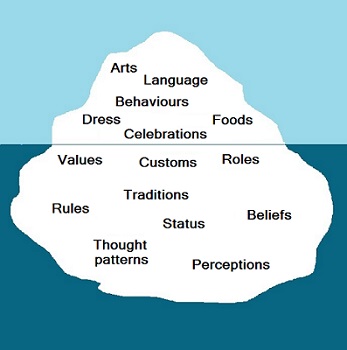
Recently, I read an article by Ogay and Edelmann (2016) that critiques the familiar iceberg model of culture and proposes three alternative metaphors for understanding how culture works. I found their argument compelling, particularly their invitation to think about culture as fluid and dynamic rather than fixed or hidden beneath the surface.
In the short video below, I introduce four metaphors for culture—including the iceberg—and explore what each one helps us see (and sometimes miss) about how culture shapes everyday classroom life.
The metaphors we use to describe culture shape how we understand it. Each metaphor highlights something important, but each also has limitations. Taken together, they can help us think more carefully about how culture operates in everyday classroom life. If you would like a quick summary, the key ideas behind each metaphor are outlined below.

This familiar metaphor reminds us that many aspects of culture lie beneath the surface—including values, assumptions, and taken-for-granted ways of interpreting the world. It encourages us to look beyond visible behaviours to consider what may be shaping them. However, the iceberg can also imply that culture is fixed and stable, as though it simply sits below the surface waiting to be uncovered.

Thinking about culture as a kind of shared language highlights how culture helps people make meaning together. Just as languages evolve and vary across contexts, cultures are dynamic, negotiated, and constantly changing. This metaphor encourages us to see culture less as something people have and more as something people do in interaction.

This metaphor emphasises that culture can be invisible precisely because it is so familiar. Like air, we often only notice it when something changes—when expectations are disrupted or when people interpret situations differently. This perspective reinforces the idea that culture operates in subtle, everyday ways and is fluid rather than fixed.

A non-Newtonian fluid behaves differently under pressure: it can shift from flowing easily to becoming suddenly firm. This metaphor reminds us that culture can also harden under pressure—for example during conflict, uncertainty, or moments of perceived threat—when people may hold more tightly to familiar ways of thinking and acting.
Questions for reflection
- Which of these metaphors most closely reflects how you currently think about culture?
- How might these metaphors help you notice cultural assumptions in your classroom—for example in communication styles, expectations about behaviour, or interpretations of student participation?
- When might culture in your classroom feel “invisible,” and when does it become more noticeable?
- How might thinking about culture as dynamic and relational influence the way you respond to misunderstanding or difference in classroom interactions?
No single metaphor can fully capture the complexity of culture. Each highlights certain dimensions while leaving others in the background. Used together, however, these metaphors can expand the ways we notice and interpret what is happening in our classrooms—encouraging us to see culture not as something fixed that students bring with them, but as something dynamic that is continually being shaped through interaction, meaning-making, and context.
Reference:
Ogay, T., & Edelmann, D. (2016). ‘Taking culture seriously’: implications for intercultural education and training. European Journal of Teacher Education, 39(3), 388–400. https://doi.org/10.1080/
Additional Resources
Student Activities
- Designed for mid-Secondary students, our FREE Defining Identities online learning module will allow your students to explore their own ‘cultural iceberg’ and how that shapes their identities.
- Online teaching resources platform cool.org has compiled a landing page of their resources for Harmony Week that promote diversity, inclusiveness, and cultural awareness in your classroom.
- Our student program, Navigating Diversity & Difference, also explores the concept of the cultural iceberg as part of a small group exploration of each others’ culture. In doing so, they develop empathy as well as cultural understanding and sensitivity through participatory activities and discussions.
- Explore culture and identity from a First Nations perspective through the free online Culture & Identity Activity by Australians Together.
Professional Learning
- Explore the idea of intercultural or diversity competence in our teacher professional learning module Diversity Education: Diversity Competence & Identity.
- AITSL have developed a cultural responsiveness toolkit, including a self-reflection tool.
- Our teacher professional learning workshop, Developing Intercultural Understanding: More Than Just Harmony Day, is design to help teachers understand how intercultural understanding can support belonging in school communities. The first step begins with developing an understanding of our own culture as an individual.
- For pre-service teachers, take a look at the professional learning course from Deakin University Becoming a Culturally Responsive Practitioner.
Further Exploration
- Take a deep dive into intercultural initiatives and policies with the 2023 academic paper by Elias and Mansouri ‘Towards a critical transformative approach to inclusive intercultural education’
About the Author
Kathleen (she/her) is a former primary school teacher, born on Mandandanji Country in Roma and now living and working on Kabi Kabi/Gubbi Gubbi Country on the Sunshine Coast, Queensland. Her family came to Australia from Scotland and Ireland in the late 1800s. Kathleen’s work as an educator reflects her commitment to social justice, peace, democratic processes, and sustainability.
Copyright
Metadata © Together for Humanity (except where otherwise indicated). Digital content © Together for Humanity (except where otherwise indicated). Video © Together for Humanity (except where otherwise indicated). All images copyright their respective owners. Text © Together for Humanity is licensed under a Creative Commons Attribution-ShareAlike 4.0 International License (CC BY-SA 4.0).
Copyright
Metadata © Together for Humanity (except where otherwise indicated). Digital content © Together for Humanity (except where otherwise indicated). Video © Together for Humanity (except where otherwise indicated). All images copyright their respective owners. Text © Together for Humanity is licensed under a Creative Commons Attribution-ShareAlike 4.0 International License (CC BY-SA 4.0).
- Stage: All
- Curriculum: All
- Topics: Culture