
From Quotes to Questions: Building Dialogue and Belonging
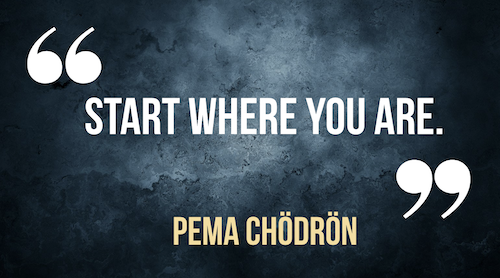
Share
Why Inspirational Quotes Matter in Teaching and Learning
Who doesn’t love an inspirational quote? This one—“Every action we take in schools to welcome those who have been traditionally marginalized reminds us that we are doing this work for all of us, helping all of us become better human beings” (1) —has been blu-tacked to the frame of my computer screen since 2019. It reminds me why this work matters, especially in challenging times.
Like many teachers, I’ve used colourful quote posters on classroom walls—sometimes as much to cover peeling paint as to motivate students (or myself). But quotes can be far more than decoration. When used intentionally, they become powerful tools for learning. They can open up complex ideas, spark classroom dialogue, support student wellbeing, and invite learners to reflect on themselves and the world around them.
A Classroom Strategy for Using Quotes to Promote Dialogue and Critical Thinking
In this post, I focus on one specific way of using inspirational quotes critically, rather than simply as affirmations. I first encountered this strategy during a webinar with the founders of Teach Different last year; it uses short, provocative quotes as a starting point for deep thinking and meaningful classroom discussion.
Instead of asking students to immediately share opinions, the approach relies on carefully structured prompts that encourage students to draw on personal experience. In doing so, it highlights the role of storytelling in learning and helps students practise listening, perspective-taking, and respectful disagreement.
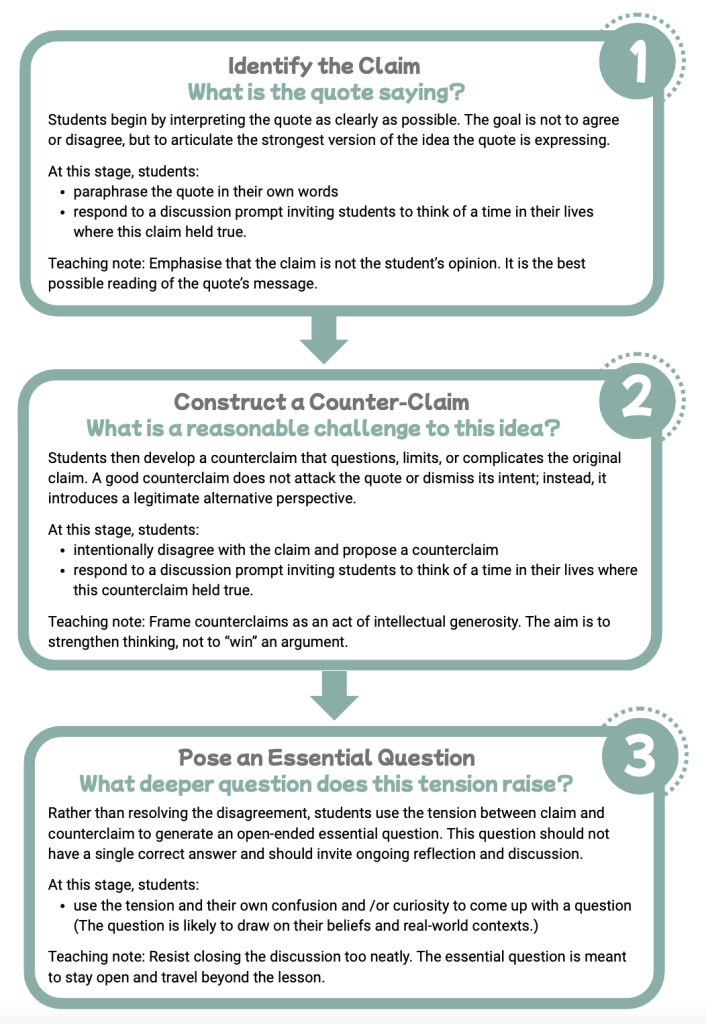
The method pictured below structures discussion through three deliberate steps: claim, counterclaim, and essential question. Download a pdf of the method here.
How to Choose Quotes That Support Meaningful Classroom Dialogue
When selecting quotes for dialogue, choose text linked to big ideas such as belonging, fairness, resilience, courage or justice. A curated list of such quotes is available for download in the resource list at the bottom of the post. Invite students to bring quotes that matter to them, from books, speeches, songs, or admired thinkers, to build ownership and widen representation in class discussions.
Remember: not all quotes suit every strategy. Those that spark many questions or tensions are especially productive for critical dialogue. For quotes that don’t lend themselves to this strategy, students might respond by creating posters, illustrations, or photo pairings—blending literacy with creativity and personal expression.
Why Structured Dialogue Builds Inclusion and Democratic Skills
By separating understanding, challenging and questioning, the Teach Different process:
- reduces polarisation and defensiveness
- teaches students how to disagree respectfully
- builds habits of democratic dialogue
Importantly, it positions the classroom as a space where thinking is valued over quick opinion, and where students learn to engage in complexity rather than avoid it.
Used consistently, quotes can reinforce shared values like respect, inclusion and belonging. They also help students find language for thoughts and emotions they might otherwise struggle to express. Quotes don’t need to be famous to be powerful—what matters most is how they’re used to invite students to think, question, connect and reflect.
Reference
1. ‘Celebrating Transgender Students in Our Classrooms and in Our Schools’. Rethinking Schools, Vol. 33, No. 2. Winter 2028-19. https://rethinkingschools.org/articles/celebrating-transgender-students-in-our-classrooms-and-in-our-schools/
Additional Resources
Student Activities
- Download this FREE curated list of quotes to use in your classroom.
Professional Learning
- Our FREE online modules Cohesion in Diversity: Dialoguing on Controversial Issues and includes Cohesion in Diversity: Transforming Curriculum both contain advice and resources that support dialogue in the classroom.
- Blog posts that focus on dialogue include What do I say? How to handle harmful comments in the classroom, and The Key to Better Conversations: How to Talk When It’s Hard to Listen.
Further Exploration
- Listen to one of many podcasts from Teach Different where the strategy is modelled. This one uses a quote by George Orwell.
- This short article about the neuroscience of storytelling demonstrates the value of students sharing their experiences.
About the Author
Kathleen (she/her) is a former primary school teacher, born on Mandandanji Country in Roma and now living and working on Kabi Kabi/Gubbi Gubbi Country on the Sunshine Coast, Queensland. Her family came to Australia from Scotland and Ireland in the late 1800s. Kathleen’s work as an educator reflects her commitment to social justice, peace, democratic processes, and sustainability.
Copyright
Metadata © Together for Humanity (except where otherwise indicated). Digital content © Together for Humanity (except where otherwise indicated). Video © Together for Humanity (except where otherwise indicated). All images copyright their respective owners. Text © Together for Humanity is licensed under a Creative Commons Attribution-ShareAlike 4.0 International License (CC BY-SA 4.0).
Copyright
Metadata © Together for Humanity (except where otherwise indicated). Digital content © Together for Humanity (except where otherwise indicated). Video © Together for Humanity (except where otherwise indicated). All images copyright their respective owners. Text © Together for Humanity is licensed under a Creative Commons Attribution-ShareAlike 4.0 International License (CC BY-SA 4.0).
- Stage: All
- Curriculum: English, Health, Humanities
- Topics: Dialogue, Belonging, Wellbeing